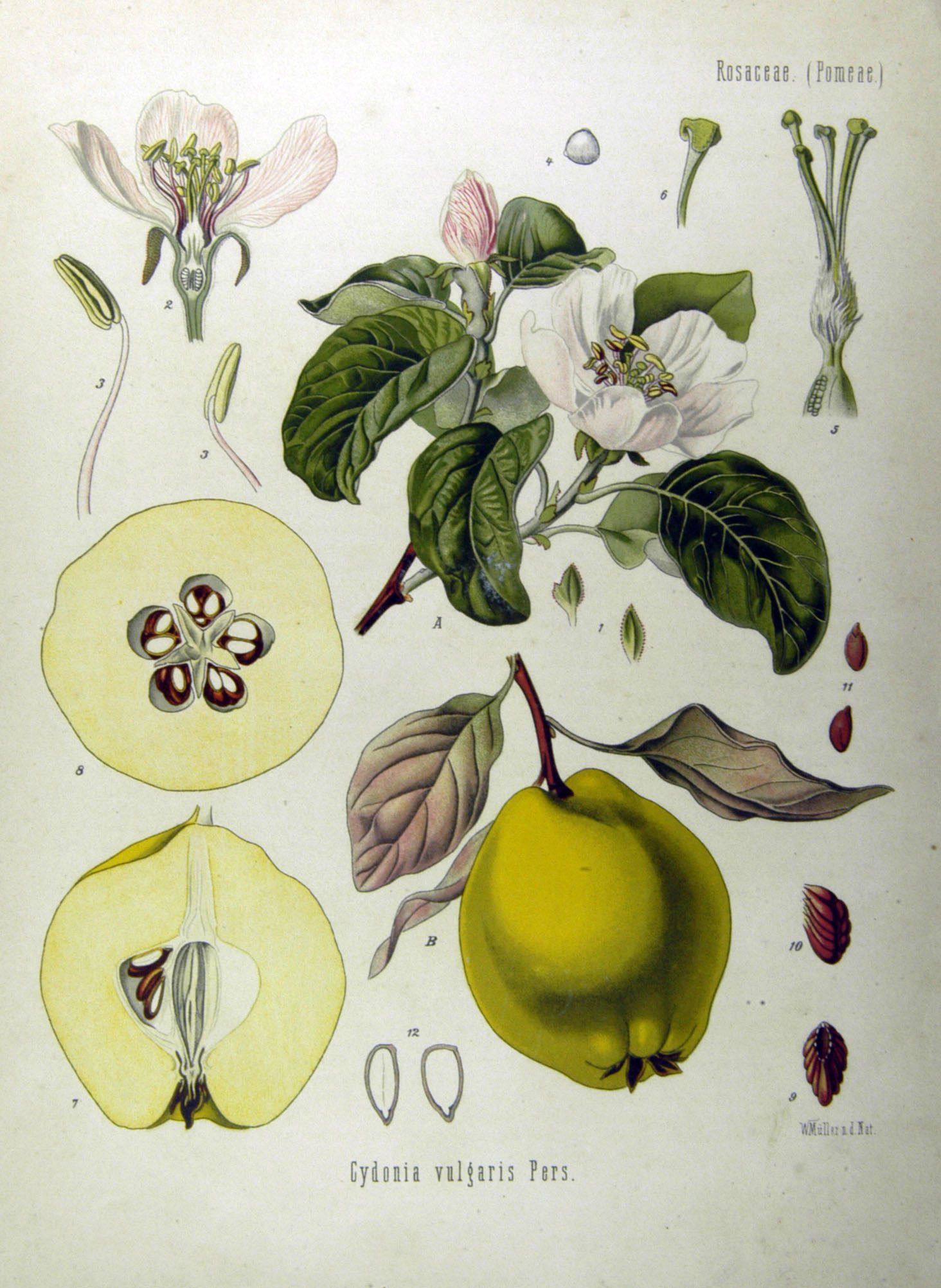
Yesterday I had a walk around our garden and noticed that the gnarled old quince tree has once again borne fruit – I just can’t reach it as it is hanging from the very top branches of the tree! The quince resembles a large bright yellow lumpy pear. It originally came from the Middle East and is native to countries such as Iran, Armenia and Kashmir, to name a few. It is an ancient fruit and cultivation of quince may have preceded apple culture; references translated as ‘apple’, such as the fruit in the Song of Songs, may have been quinces. In ancient Greece, the quince was the fruit of love, marriage and fertility and was often given as a wedding gift to a bride to sweeten her breath. The quince came to England in 1275 when Edward I ordered that quince trees be planted at the Tower of London. It became a popular ingredient in jams, jellies, crumbles and pies. In Medieval England, quince paste was prescribed by apothecaries to help digestion. This may have been why it was often served with rich meats or after the meal. The Victorians enjoyed quince tart at Christmas and it is mentioned in the Edward Lear poem ‘The Owl and the Pussy Cat’: “They dined on mince and slices of quince, which they ate with a runcible spoon.’ I was surprised and delighted the first time I spotted the quince next to the plum tree in our garden.
Quince Tanka
Aphrodite’s quince
Nibbled to perfume her kiss
Sealed her married bliss
In Spring pink flowers unfold
Autumn’s perfumed orbs are gold
 writing in north norfolk