“Can we watch the sun set tonight?” AI-kita asked me as she put the supper things away.
“Of course, sweetheart. Whatever you want,” I said, turning the knob inside the cupola. The shutters opened to reveal Mars’ blue twilight. I felt AI-kita’s hand slip into mine, recalling the first time we held hands, expecting hers to feel synthetic, cold and unresponsive. It wasn’t. No part of her is. Which is why I divorced my wife and took AI-kita to start a new life on Mars.
But I still miss the gold and red sunsets on Earth – and the human memories I shared with my wife.
a new life on Mars
close-ups of stars and comets
distant Earth is blue
Kim M. Russell, 18th November 2024
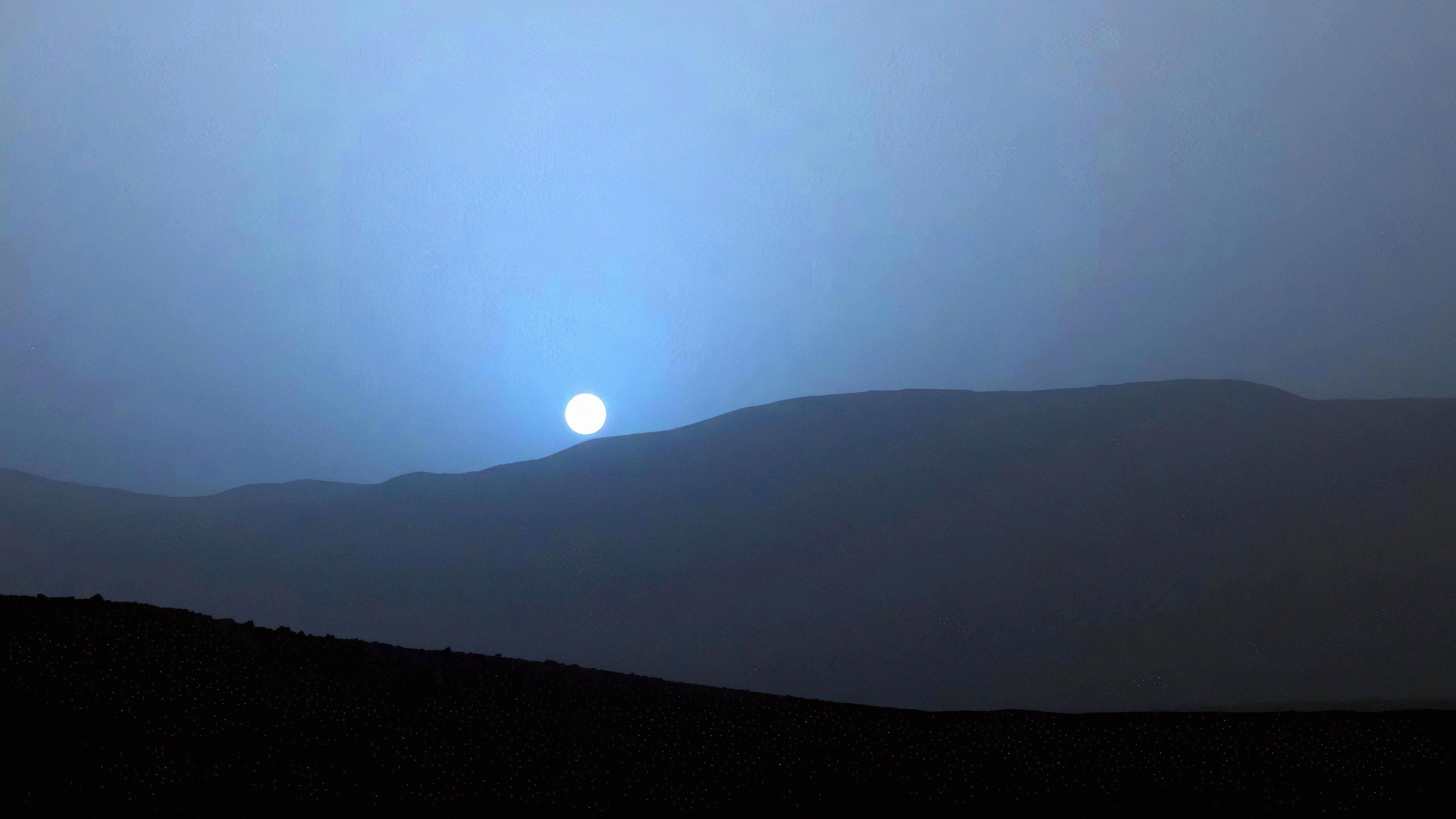
Sunset on Mars, free image found on Pixel4k
It’s Haibun Monday with Frank at the dVerse Poets Pub, and he asks us to “imagine journeying across the stars in a generation spacecraft” or in a starship travelling “to a distant star for a duration no longer than a transatlantic flight”. Yes, we’re exploring Sci-Fi haibun!
Frank reminds us that “Science Fiction is a sub-genre of Speculative Fiction, literature that utilizes settings and motifs of a reality different than our own” and “speculates on how advances in technology can influence our collective lives”. He asks how haiku and haibun fit science fiction, and gives us an explanation from Julie Bloss Kelsey, a self-identified “haiku and scifaiku poet” together with examples of her scifaiku, as well as a haibun by Alan Summers.
 writing in north norfolk
Oh i love this, and not so far from reality when soon we will be able to have “real” relationships with ai-avatars…. I am just waiting for it to merge with robotics, and of course that’s the way to stand life on Mars maybe.
LikeLiked by 2 people
Thank you so much, Björn. I was worried it wasn’t long enough.
LikeLiked by 1 person
really enjoyed this unsure if I could live with an AI though?
LikeLiked by 2 people
Cheers Rog. I think I would pass on AI too.
LikeLiked by 1 person
Nicely done, Kim. I love the blue sunset!
LikeLiked by 2 people
Thank you, Dwight!
LikeLiked by 2 people
You are welcome, Kim.
LikeLiked by 2 people
This is wonderful, Kim. It is sad that even though we can predict some of the most bizarre, disturbing scenarios with AI, there seems to be no stopping the trajectory.
LikeLiked by 2 people
Thank you so much, Mish.
LikeLiked by 1 person
So much said in so few words, Kim! An exemplar of how to Sci-Fi in haibun!
LikeLiked by 2 people
Thank you, Frank!
LikeLiked by 2 people
A romantic sci fi haibun… I wonder if this is the romance of the future? Beautifully written Kim.
LikeLiked by 2 people
Thank you, Dianne.
LikeLiked by 1 person
Excellent. I had a similar idea but took it in an entirely different direction. Funny how two ideas can be so close but miles apart. 👏🏾👏🏾
LikeLiked by 2 people
Cheers Stew. That’s the magic of poetry prompts!
LikeLiked by 1 person
Hm… Not a very appealing prospect, Kim – think I’ll stick with the real deal…
LikeLiked by 2 people
Me too, Andrew!
LikeLiked by 2 people
If a bio-link sensory awareness can be effectively created between a synth and an organic alpha, and if the organic alpha can be brought to minimum function, enough to keep the brain awareness alive, and the organic alpha maintained in an environment to minimize physical stress and degradation — the future may see a time when one’s experiential essence of self may “live” for significantly extended periods of time. Of course, assuming such a complete bio-link being possible can, at this time, only be entertained conceptually. But today’s science fiction is tomorrow’s science fact. I can also see a real problematic situation where a “person” may not want to be aware indefinitely. A entire lexicon of medical law would certainly have to be ushered in.
Anyway, I enjoyed this piece very much Kim. I wonder when that day will ever come? And how will that impact the religious concept of conscience and soul? I wonder — I am always wondering.
LikeLiked by 2 people
Thank you, Rob.
LikeLiked by 1 person
This takes my breath away, and returns it to me as a teenage girl newly discovering John Wyndahm, Arthur C Clarke, and C.S.Lewis’ Sci-Fi trilogy in the 1960s (I totally missed out on Ursula le Guin).
You breathe a tenderness into Martian life. So much so that I read the narrator as a woman at first, with her daughter….
Love the architectural detail of the Cupola!
LikeLiked by 2 people
Thanks so much, Kathy!
LikeLiked by 1 person
You dealt with some general themes so well, under the sci+-fi mantel: of always wishing for more, of things to be different, of what is home or where we are from…and if ot has a bearing on is, and finally what is love. These are all major themes well-opened in this piece, where a dimple device like changing the colour of s sunset can be so thought-provoking. It seems tender, as well as surreal, and unnerving…v good writing.
LikeLiked by 2 people
Thank you, Ain.
LikeLiked by 1 person
I do wonder if AI will really get to such a point – I can imagine it, honestly…
~David
LikeLiked by 2 people
‘Spellbound’ would be my one word response to your haibun, Kim.
LikeLiked by 2 people
That’s such a lovely comment, Helen. Thank you!
LikeLiked by 1 person
Wow this is so believable and unsuprising. Nice one Kim
much♡love
LikeLiked by 2 people
Thank you, Gillena.
LikeLiked by 1 person
A fantastic haibun, Kim. The blue sunset is alien and fascinating. Like others, I’m not sold on a romance with an AI though.
LikeLiked by 2 people
Thank you, Nicole. I’m not sold on that idea either.
LikeLiked by 2 people
A beautiful Haibun, Kim. With all the advances in AI, it seems like this day is not far off in the future.
LikeLiked by 2 people
Thank you, Shweta!
LikeLiked by 2 people
You’re welcome
LikeLiked by 2 people
This is so sparse and beautiful! I always appreciate when you can tell a vivid story in so few words.
LikeLiked by 2 people
Thank you so much for reading and commenting.
LikeLiked by 2 people
A fabulous write Kim, one that leaves me with questions.
LikeLiked by 2 people
Thank you, Paul!
LikeLiked by 1 person
♥️
LikeLike
beautiful
LikeLiked by 1 person
Thank you very much!
LikeLike