brine-tumbled pebble
abandoned by the ocean
on a lonely beach
I hear the wind’s threnody
floating on the next high tide
© Kim M. Russell, 2016
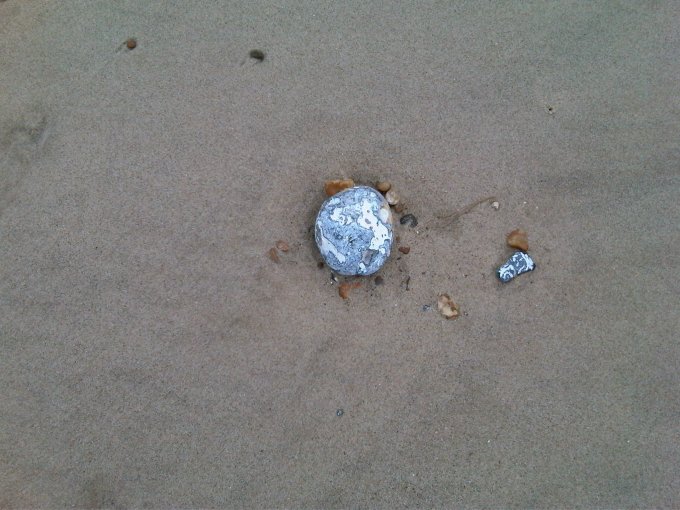
My response to Carpe Diem Tanka Splendor #10 Teika’s 4th Tanka Writing Technique – convicting feeling (abandoned beach)
In Carpe Diem’s Tanka Splendor month, we are exploring the Ten Tanka Writing Techniques by Teika. Today Chèvrefeuille has introduced us to Teika’s 4th Tanka Writing Technique: ‘convicting feeling’, ushintei, which he says is Teika’s most famous poetical ideal, the quality that must be part of every good poem. Teika felt this could not be an adopted ‘style’ but could result only if the poet ‘approached the art with the utmost seriousness and concentration’. Another interpretation of the style is that it uses a highly subjective sense in which the speaker’s feelings pervade the imagery and rhetoric of the poem. It is especially appropriate for poems expressing love or grief. As an example, he has shared the following poem by Princess Shikishi, #9:1034 in the Shinkokinshū:
tama no o yo / taenaba taene / nagaraeba / shinoburu koto no / yowari mo zo suru
jewel of my soul
threaded on the string
that should break
how to endure these things
I am getting weaker
Chèvrefeuille explained the technique further as something that catches your attention, a scene just around the corner that you try to capture in your poem as you first write down what you have seen. Then you read your notes over again: you can see the scene in front of your eyes and then you look at it from a distance, detach yourself as if you weren’t there. The scene comes alive. What do you see? What feeling does the scene convey? Concentrate on the scene, think it over, contemplate it and the scene will unfold in your poem.
 writing in north norfolk
Very evocative!
LikeLiked by 1 person
Thank you!
LikeLike
Agree with Thotpurge.
LikeLiked by 1 person
Beautiful!
LikeLiked by 1 person
Thank you!
LikeLike
The loneliness echoes…and i appreciate your use of “threnody”! (i learned a new word…thanks!)
LikeLiked by 1 person
Thank you for reading, Lynn!
LikeLike
A beautiful tanka Kim … you have used the Tanka Technique in a subtle way.
LikeLiked by 1 person
Thank you, Kristjaan, all the way from Poland! I’m using my husband’s iPad so won’t be posting until Sunday.
LikeLiked by 1 person