Bleached
whale bones
radiate sizzling
silence among slow
dissolution and frozen
indifference of icebergs.
Vague swimming shadows
in depths and shallows
of ultramarine blue
shun sulphur sun
and melting
beach.
Kim M. Russell, 2017
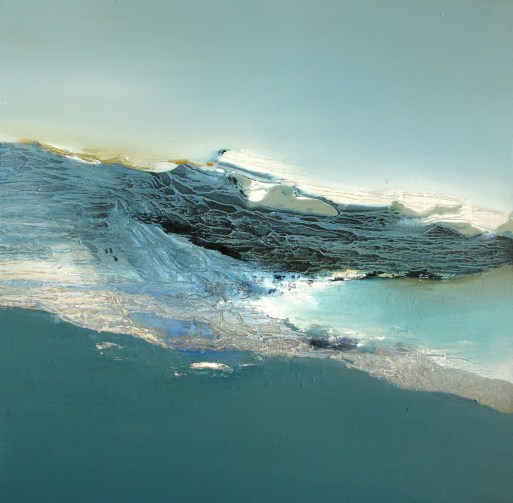
Elaine Jones ‘3 Tundra’ image found on Pinterest
My response to dVerse Poets Pub Meet the Bar with Impressionism
Today Björn is hosting and continuing with the journey through the world of art. He wants us to look deeper into impressionism, with its light brushstrokes and blurred edges – hinting rather than being exact.
Björn tells us that Impressionism has always been seen as a French movement with artists like Monet, Renoir and Cezanne. He says that, at first, their ideas were thought to be too radical but he thinks that impressionism has become the essence of good art. He has reminded us of their techniques:
- They use short, thick strokes of paint quickly to capture the essence of the subject, rather than its details.
- Colours are applied side-by-side with as little mixing as possible in opaque fields, producing contrasts of vivid colours.
- Wet paint is painted on top of wet paint, blurring the edges.
- Greys and dark tones are produced by mixing complementary colours. They avoid the use of black paint. Impressionists always start from a light background.
- Wet paint is placed into wet paint without waiting for successive applications to dry, producing softer edges and intermingling of colour.
- The play of natural light is emphasized, with special attention to reflection. The preferred light is that of dawn or twilight.
- They prefer open air painting.
Our challenge is to capture these ideas in poetry. What would a short thick stroke or a bright colour correspond to in words? Björn suggests writing in separate pieces that capture moments or images, which should be from nature, such as clear nocturnal skies, and add some people, maybe food, and thus create a scene, avoiding darkness and including some laughter, He also says to paint them nor only by the names of the colours but even more with objects that have particular shades or hues.
 writing in north norfolk
Love the visuals.
LikeLiked by 1 person
Thanks David!
LikeLiked by 1 person
I love the scenery your have painted with the ice and the whales… so alive and mighty.
LikeLiked by 1 person
Thank you, Bjorn!
LikeLike
The sounds in this poem, the alliterative s….the splashes of intense color. And melting beach…be still my heart. This is perfect.
LikeLiked by 1 person
I’m glad I’ve ‘impressed’ you, Toni!
LikeLike
An excellent poem–very much in line with the prompt, & would make a perfect gallery tag for your image. I do love me some alliteration.
LikeLiked by 1 person
Thanks Glenn!
LikeLike
Now that is impressionistic, Kim.
LikeLiked by 1 person
Thank you, Jane!
LikeLiked by 1 person
I liked the “indifference of icebergs” toward the whale bones and the silence that sizzles.
LikeLiked by 1 person
Thank you, Frank! Another day has dawned here and I’m just about to resume my reading – starting with your impressionist poem.
LikeLiked by 1 person
I liked the picture you “painted” with your words. And the form and shape you used were inspired.
LikeLiked by 1 person
Thank you, Candy!
LikeLike
Brava.. 🌹🌹🌹
LikeLiked by 1 person
Thanks Dorna!
LikeLike
Not only were your words wonderful, they were presented in perfect shape! Impressionistic AND impressive!
LikeLiked by 1 person
Thank you so much Bev for your kind comments.
LikeLike
Nice, Kim…richly primitive and moving for such a geographical piece of art…you brought out the soul of the tundra.
LikeLiked by 1 person
Thank you, Kathy!
LikeLike
You know, I never would have associated the tundra with impressionism, but you did it, woman. You in the Arctic, Toni in the kitchen, Van Gogh in the Coal Mines…an eye-opener.
LikeLiked by 1 person
🙂
LikeLike
Love that silence and ultramarine blue shunning sulpher sun Kim ~ You made nature come alive beautifully ~
LikeLiked by 1 person
Thank you, Grace. I’m not long up and about to read more impressionist poems 🙂
LikeLike
Whoa. I like this very much. Frozen indifference of icebergs. Ain’t that the truth! Very nice and certainly fills the prompt.
LikeLiked by 1 person
Thanks Jane! I hope you’re well and not battling with snow at the moment.
LikeLike
No, Kim…I’m battling depression and a crazy 97 year old biological mother. That is the extent of it all. Slim pickings for air.
LikeLiked by 1 person
I’ve been there – I’m thinking if you 💐
LikeLiked by 1 person
That last message should have said I’m thinking of you.
LikeLiked by 1 person
Wow, a captivating write!
LikeLiked by 1 person
Such a lovely comment, Thank you, Lynn!
LikeLike
the myriad of hues we don’t see sometimes obscured by the larger pieces of colour – love how you highlighted them here.
LikeLiked by 1 person
Thank you!
LikeLiked by 1 person
I liked the shape of the poem as well as the impression of Blue.
LikeLiked by 1 person
Thank you, Sarah!
LikeLiked by 1 person
Bleached
whale bones
radiate sizzling
It certainly looked like little thick strokes to start it going! Rightly so Kim!
Hank
LikeLiked by 1 person
Thanks for your valued comments, Hank!
LikeLike
Thick strokes ebb and then flow…sumptuous wordage and a fine physical form
LikeLiked by 1 person
Thank you, Paul!
LikeLike
Suddenly the tundra feels warm. I like the way you paint!
LikeLiked by 1 person
Thank you. Mish!
LikeLike
Love your life and death play ending with the shadows. Nice, Kim!
LikeLiked by 1 person
Thanks Bekkie!
LikeLiked by 1 person
Impressionism as you stroke allows a fleeting surface eye which sees our random and tandem failings writ large in the world. Maybe the immensity of some condemnation and grief can only be seen that way. The bolded second stanza offers an offshore diving critique. Happy see you diving back into your vault of treasures to bring poems like this to light anew! – Brendan
LikeLiked by 1 person
Thanks Brendan. Looking at the archives is a good exercise – I’ve forgotten a lot of the poems from past years and a pleasure to find something to share or work on.
LikeLike
Masterful use of alliteration and assonance to shape this impressive impressionistic poem, Kim!
LikeLiked by 1 person
Thanks Ingrid! I had forgotten about this poem and was pleased to discover it in the archives.
LikeLiked by 1 person
Wow! This poem is so wonderful out loud. Well done Kim!
LikeLiked by 1 person
Thank you, Kim!
LikeLiked by 1 person
Wonderful imagery! I can see those bleached whale bones. We have them here, too.
LikeLiked by 1 person
Thank you, Sherry!
LikeLike