Snow spilled into her boots,
           over her socks,
                    freezing her toes.
She’d risen late, tricked
by the shadowy darkness of snow
           piled
                    up to the gutter.
They would be hungry,
           stamping on frozen ground,
                    their hooves a hollow sound.

They couldn’t graze.
Her husband had released them before work;
by the time she’d crunched
through the greying crust
of snowpack, a pale lemon sun
was straining through frosty mist
that hung over the paddock.

They were huddled together,
their grey coats blue,
           like her gloveless fingers
                   gripping the buckets of oats.
Although the ice in the troughs
had been broken,  it had started to form again.

When she opened the stable doors,
the rattle of the bolts brought
all four horses trotting towards her,
their hooves ringing on the iron ground.

Kim M. Russell, 23rd July 2024
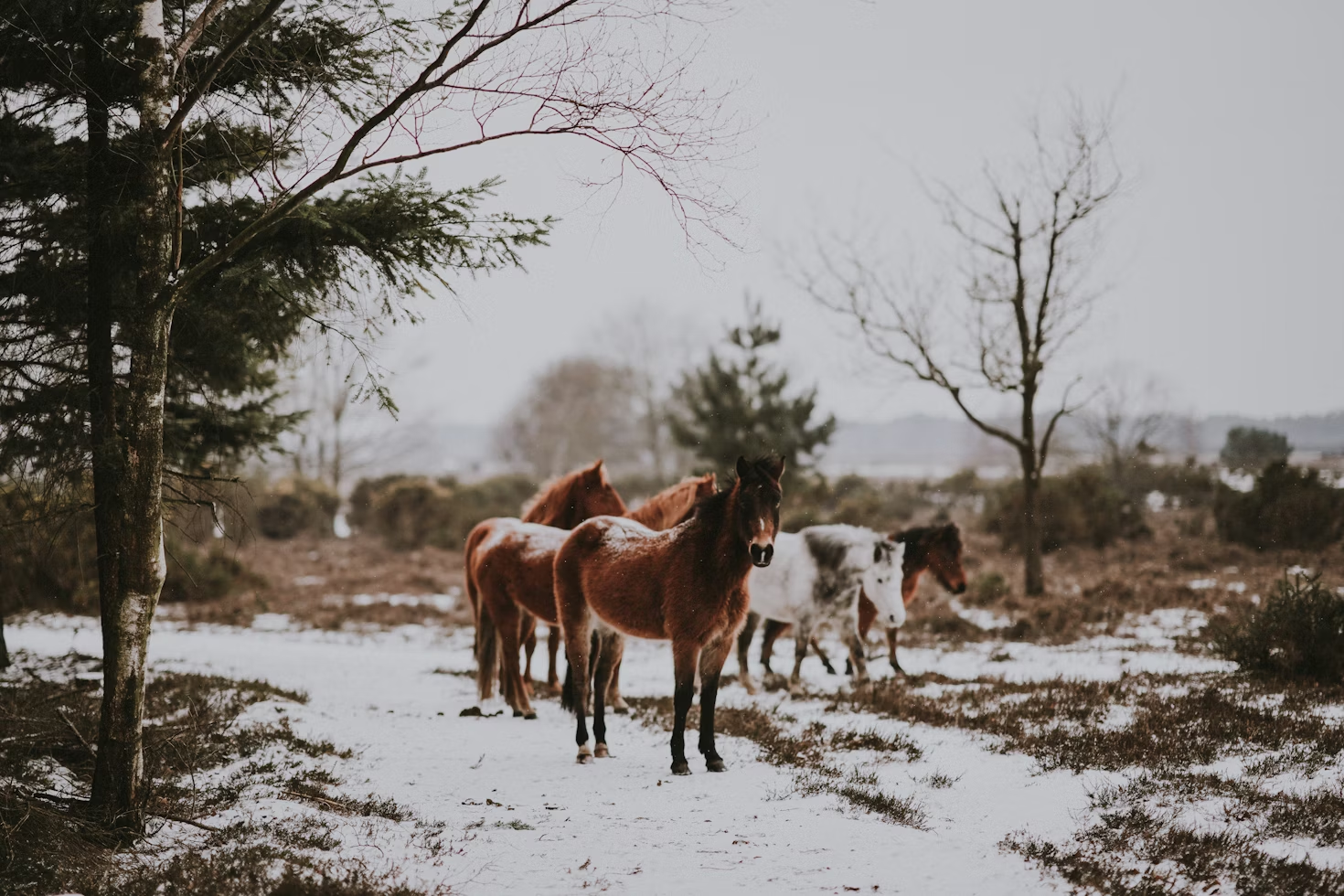
Image by Annie Spratt on Unsplash
This Tuesday, Dora is our host for Poetics at the dVerse Poets Pub, and she has us running with horses. She has given us a potted history of horses, which she have been ‘part of our landscape and imagination for thousands of years throughout many parts of the world’.
Dora asks us to use horse imagery in any way we like, either as the focus of our poems or in passing, in allusion or metaphor, or just a mention will do. To inspire us, she has shared some fantastic poems by Jim Harrison, Pablo Neruda, Walt Whitman, Douglas Malloch, Ted Hughes, Edwin Muir, Mary Oliver, Ada Limón and Emily Dickinson.
I have rewritten an old piece of flash fiction into a poem. I wrote the original after a particularly cold winter, when I visited the local horses every day.
 writing in north norfolk
Even in this summer heat I can feel my fingers turning blue with cold, so effectively do your words convey the frozen landscape, the urgency of need both of the woman and the horses, as they stamp the ground.
I love how the poem takes on the aspect of a painting too, images dawning in our minds through lines like these: “by the time she’d crunched
through the greying crust
of snowpack, a pale lemon sun
was straining through frosty mist
that hung over the paddock.”
Beautifully crafted, Kim.
LikeLiked by 1 person
Thank you so much, Dora.
LikeLiked by 1 person
You evoke that cold day with poetic exactitude. I was there with you Kim. An excellent poem!
LikeLiked by 1 person
Thank you very much, Kim!
LikeLike
Great story in a poem. I could feel the cold and see the horses and ice.
LikeLiked by 1 person
Thank you so much, Rebecca.
LikeLiked by 1 person
The wildness of the encounter – which I think we must always have, no matter how domestic the arrangement – here depends on the bitter winter weather, which the wild animals endure and the person bringing food must go far from the comfort of home to offer. That’s a wild greeting from both sides!
LikeLiked by 1 person
Cheers Brendan!
LikeLike
Lovely poem, Kim!
LikeLiked by 1 person
Thank you, Nolcha!
LikeLiked by 1 person
A great story, Kim. Winter presents challenges for farmers and their animals.
LikeLiked by 1 person
Thank you, Dwight.
LikeLike
I like how you capture this scene so vividly. I can feel the cold, her crunch on the frosted ground, the restless horses waiting to be fed–such an evocative poem, Kim.
LikeLiked by 1 person
Thanks so much, Merril!
LikeLiked by 1 person
You’re welcome, Kim!
LikeLike
You paint the scene so evocatively , Kim! I love how you turn the mundane task of feeding the horses into an experience of poetic beauty.
LikeLiked by 1 person
Thank you, Punam. I haven’t fed horses for a long time, but the memory is there.
LikeLiked by 1 person
And such a wonderful memory! You are so welcome, Kim.
LikeLike
The sounds, the stamping and the crisp snow reminded me of the Robert Frost poem. Very atmospheric!
LikeLiked by 1 person
Thank you, Jane, especially the reference to the Robert Frost poem.
LikeLike
xx
LikeLiked by 1 person
Excellent writing Kim. I enjoyed the read my friend. Most engaging. ✌🏼🫶🏼
LikeLiked by 1 person
Thank you, Rob!
LikeLike
Such a sensuous winter scene you’ve captured here, Kim, and especially through your evocative repetitions of sound! These lines were my favorite:
by the time she’d crunched
through the greying crust
of snowpack, a pale lemon sun
was straining through frosty mist
that hung over the paddock.
LikeLiked by 1 person
Thank you for your kind appreciation, Chris.
LikeLike
An excellent description of how important and interdependent the connection between animal and human can be. Your poem is probably an illustration also of what happens when we deprive an animal of the opportunity to move away from inhospitable conditions. What would happen if there was no human to care for these wonderful creatures?
LikeLiked by 1 person
Thank you, Sean. When I was living in Ireland in the early eighties, we were snowed in, right up to the roof, and had to be dug out. The poor cattle in the land behind the house we were living in had no way of getting water from the trough that were iced over, so they relied on us to break the ice, and the same for the horses, because the owners could not get through the snow.
LikeLiked by 1 person
A vivid evocation of the kind of animal encounters that stay with you forever, Kim…
LikeLiked by 1 person
Thanks so much, Andrew.
LikeLike
This is very vivid and descriptive, Kim.
LikeLiked by 1 person
Thank you, Robbie!
LikeLike
This is so enjoyable, Kim. Makes me want to read the prose/flash fiction story!
LikeLiked by 1 person
Thank you, Jennifer!
LikeLike