‘I hear those voices that will not be drowned’, from Benjamin Britten’s opera, Peter Grimes.
Pebbles slip and roll beneath our soles
on the slope down to the ebb and swell.
Suddenly it erupts from the shingle beach,
a sculpture, two halves of a broken shell
like hands extended to a passing gull
or a cloud, one half upright,
the polished surface facing the sea,
catching the scattering light.
The giant steel shell degenerates,
rusted and broken by waves and time,
gently towards a state of collapse.
For a photographic moment, the scallop is mine.
Kim M. Russell, 14th August 2024
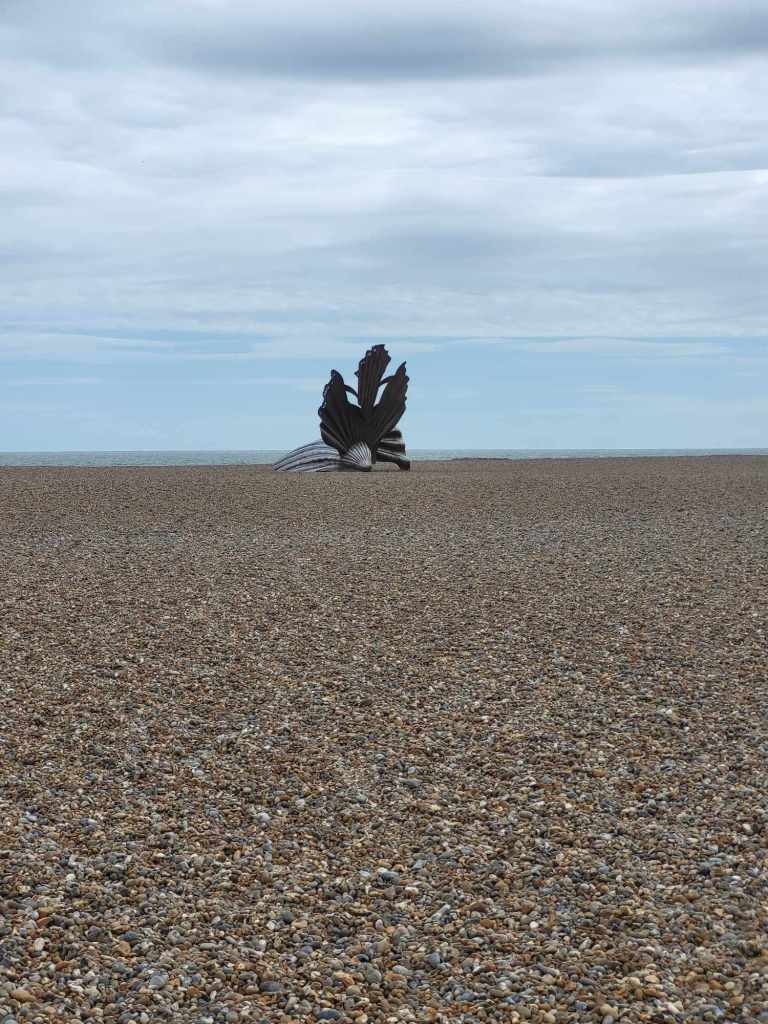
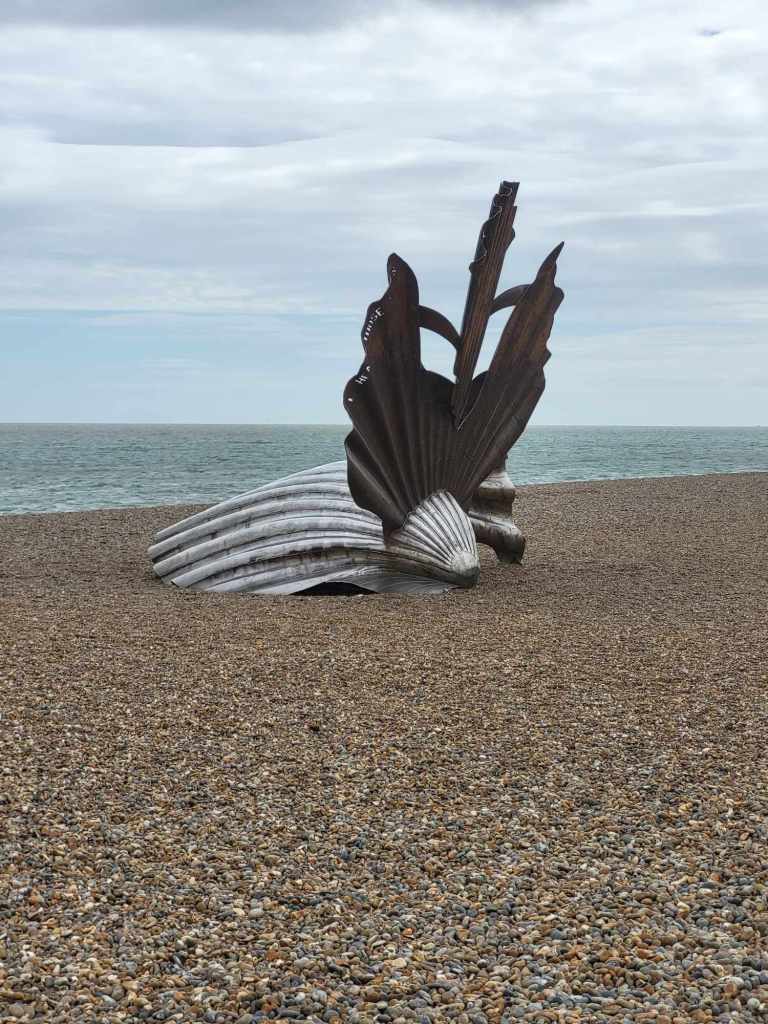
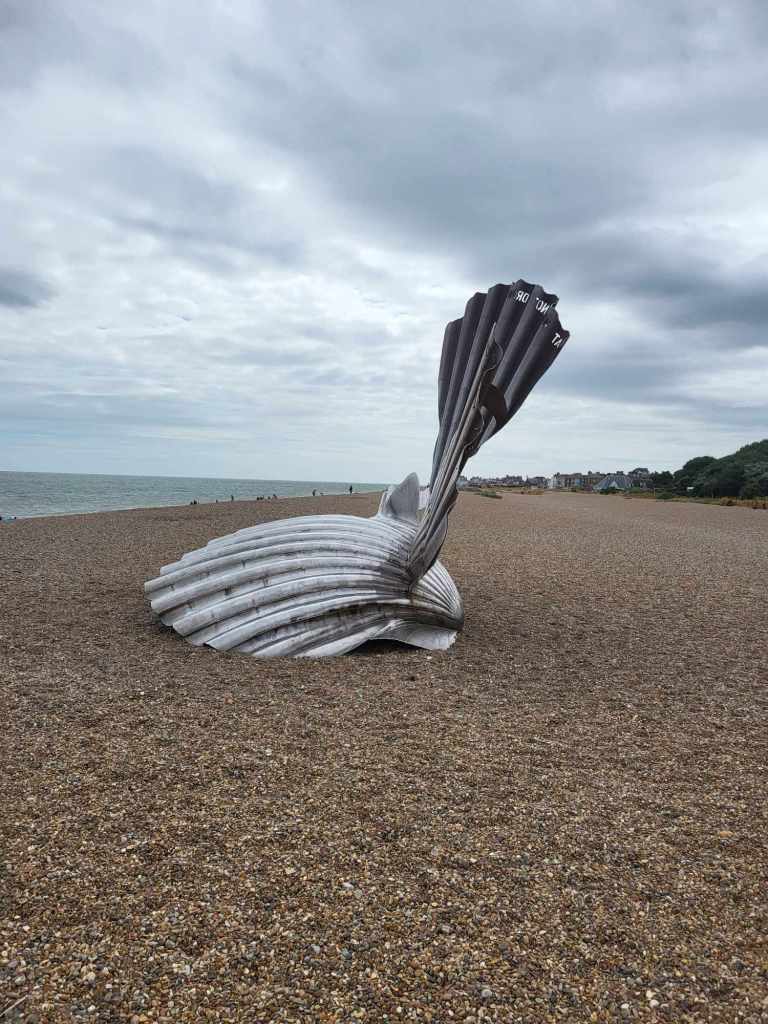
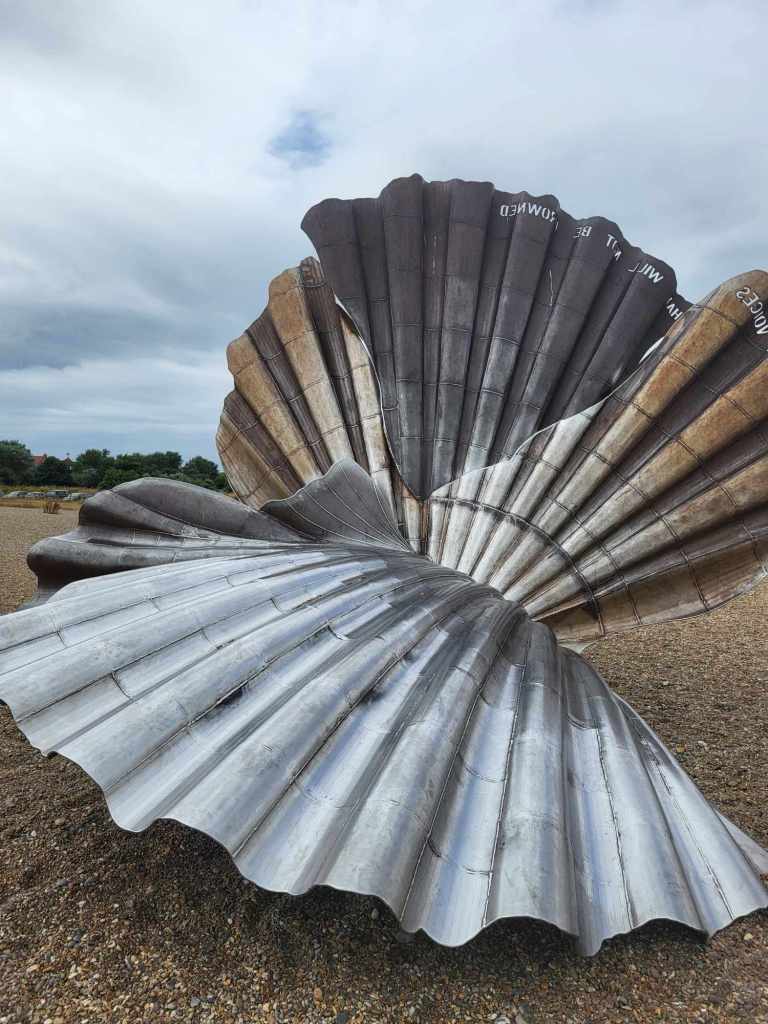
Scallop: A Conversation with the Sea 2003 by Maggi Hambling, photographed my me.
My poem for the dVerse Poets Pub Open Link Night/Live.
On my birthday, my husband drove us for an hour and a half down to Aldeburgh, a little seaside town on the Suffolk coast. For some time, I’ve wanted to visit Benjamin Britten’s home and inspiration, and Maggi Hambling’s tribute to him.
Scallop was created by Hambling in 2003. Fabricated from steel , it is made up of the two halves of a broken shell. ‘I hear those voices that will not be drowned’ from Benjamin Britten’s opera, Peter Grimes is cut into the sculpture’s upper edge.
For Maggi Hambling, Scallop is more than just a sculpture; she designed it to also be a shelter and a seat, where visitors can rest and ‘contemplate the mysterious power of the sea’, and interact with it. She wasn’t paid for it; it was not a commission but a labour of love, a gift from the artist for everyone to enjoy.
 writing in north norfolk
I LOVE the poem. I LOVE especially the 2nd and 4th photos here and THANK you for the explanation of the sculpture. How amazing to see this in the middle of a beach! So glad you posted this today.
LikeLiked by 1 person
Effortless rhyming here, Kim (and “effortless” is sometimes difficult!) . The alliteration in the first two lines is wonderful…JIM
LikeLiked by 2 people
Thank you most kindly, Jim.
LikeLike
Your poem is beautiful and a wonderful tribute to Maggi Hambling’s gift of art gracing the beach. How thoughtful the shell is also a seat where people can rest. ☺️
LikeLiked by 2 people
Thank you, Christine. Its amazing to look back at pictures taken when the Scallop first went up, when it was shiny and new. A lot of people complained about it back then, but now everyone loves it. We’re going back up the Norfolk coast in the next couple of weeks, to Wells, where there is a rusting metal horse sculpture on the beach.
LikeLiked by 2 people
Sounds delightful Kim! Enjoy it ☺️
LikeLiked by 1 person
Totally lovely!
LikeLiked by 2 people
Thank you, Carol!
LikeLike
I love your interesting poem. What a great sculpture! I know you had a great visit there.
LikeLiked by 2 people
Thank you, Dwight. We had a lovely afternoon, and the weather was perfect.
LikeLiked by 1 person
You are very welcome, Kim. Great! It is finally cooling down to the 80s F here!
LikeLiked by 1 person
I love it, and especially that last line. We do try to freeze time in those moments.
LikeLiked by 2 people
Thank you, Melissa.
LikeLiked by 1 person
The epigraph is powerful proscenium to your own verse encounter with those voices still resonant by and of the sea. About a decade late I now come to Barry Cunliffe’s theory that the Celtic language and culture didn’t migrate from the east of Gaul and Germanic tribes but began actually along the western seaboard of Europe from Spain up to France and Britain, Ireland and Scotland up to the Orkneys, beginning around 4,000 BC with Bronze Age bell beaker culture. (It would later spread east to the Gauls who invaded Rome and settled eventually in Turkey). A sea-faring, sea-singing people still resonant in Britten and your poem.
LikeLiked by 2 people
Cheers Brendan.
LikeLike
From Britten to Hambling to You, Kim, what a nexus of inspiration in this poem!
LikeLiked by 2 people
Thanks so much, Andrew!
LikeLike
Beautifully done. I had to image google the scallop sculpture to see it close up and the rusting wear made me sad. I wonder if one can still sit on it.
LikeLiked by 2 people
Thank you, Colleen. I saw people sitting on it, but somehow couldn’t sit on it myself.
LikeLike
What an amazing sculpture. And what a wonderful tribute, Kim!
LikeLiked by 2 people
Thank you, Nolcha!
LikeLiked by 1 person
Husband is from that neck of the woods and used to visit Aldeburgh. I’m not a fan of Britten, but I like the Sea Interludes. Peter Grimes is creepy though.
Your poem, the pebble beach and the rusting scallop have the Sea Interludes as background music. Lovely.
LikeLiked by 2 people
Merci beaucoup!
LikeLike
xx
LikeLiked by 1 person
❤ ❤ ❤ Kim, love every bit of this, from you and hub driving there to the afterword. I can see why you wanted to go there and love the inspiration you found there.
LikeLiked by 2 people
Thank you very much, Lisa!
LikeLiked by 1 person
You are welcome, my friend.
LikeLiked by 1 person
What a lovely poem for al fascinating picture. Pebble
S on the beach seems very English to me.
LikeLiked by 2 people
Thank you, Robbie. It’s a slide show and there should be four photos. You have to click on the arrows.
LikeLike
Thank you, Robbie. It’s a slide show and there should be four photos. You have to click on the dots bottom left of the image.
LikeLike
Oh great, the close ups are fabulous. I completely missed the arrow 🤗
LikeLiked by 1 person
This is so lovely, Kim! 😍 I especially love; “Suddenly it erupts from the shingle beach,
a sculpture, two halves of a broken shell like hands extended to a passing gull or a cloud.”❤️❤️
LikeLiked by 2 people
Thank you, Sanaa!❤
LikeLike
Oh, what a lovely bit of seaside alchemy—pebbles plotting mischief, a shell that seems ready to applaud a passing cloud, and time itself taking up welding as a hobby. I half expect the scallop to whisper ancient gossip about the tides. Brilliant and delightfully strange! 🐚
LikeLiked by 1 person
I’m delighted you enjoyed it!
LikeLiked by 1 person