I take them with me on a walk
to write, record an inner talk:
my notebooks.
Lined pages are for handwriting,
snowy plain pages for drawing
in sketchbooks.
At night before I go to sleep,
I read; beside the bed I keep
storybooks.
I switch between them now and then,
remembering each one again
with bookmarks.
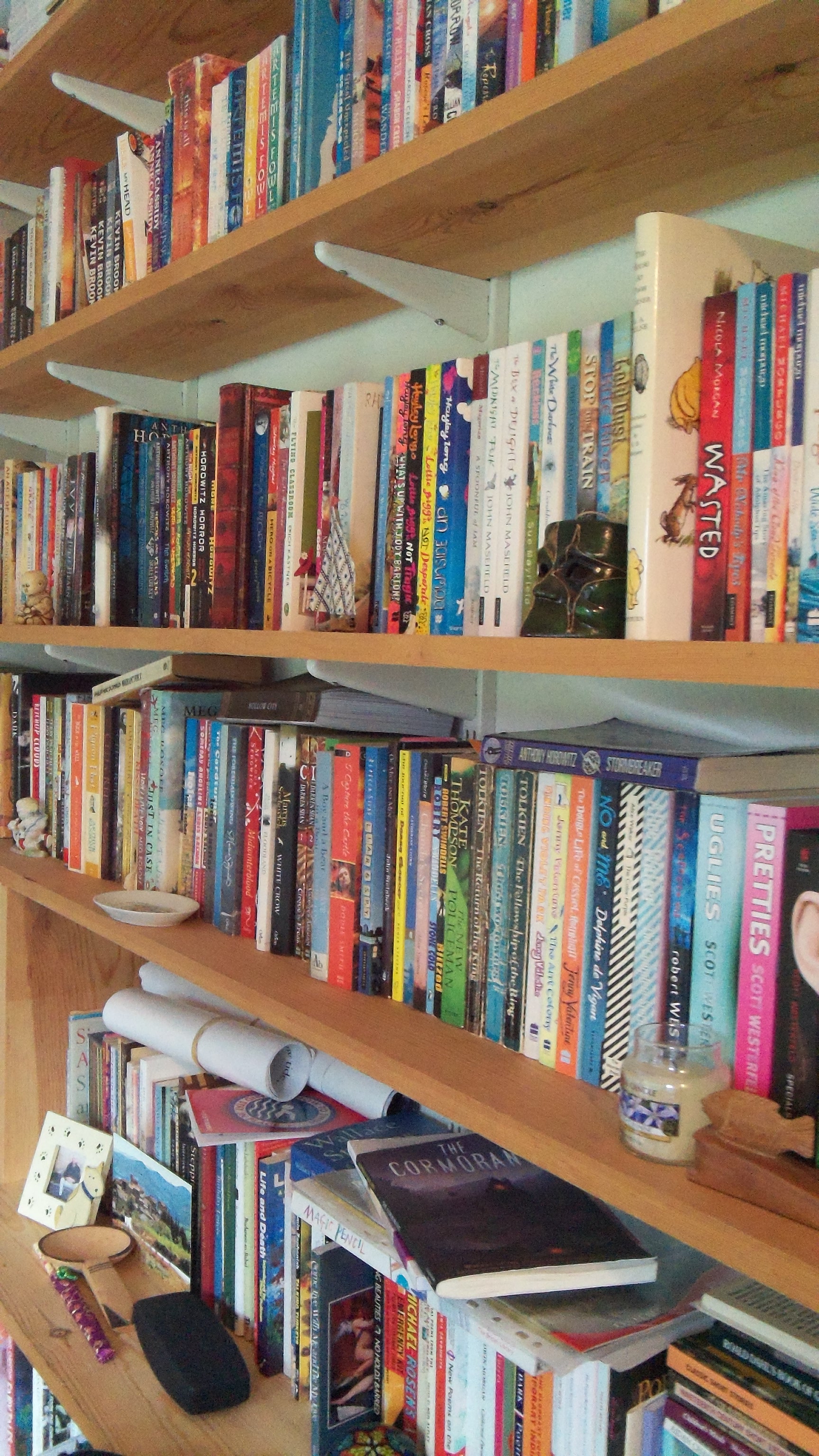
Together on a bookcase shelved,
notebooks and stories are both held
by bookends.
Kim M. Russell, 20th August 2026
Today at the dVerse Poets Pub we are meeting the bar by compounding the stem with Laura, who tells us that in his poem ‘The Mower against Gardens’ Andrew Marvell “intimates that many gardening techniques create hybrid mixtures as mix-ups, compounded by such combining.” Similarly Daniel Defoe describes the mixtures of races that makes up our lineage in ‘From the Trueborn Englishman’.
Laura says that “perhaps as a consequence of such admixtures, our language became broader and thus richer not least with the construction of kenning words from the Norse such as ‘flame-farewelled’ for death and ‘whale road’ for the sea” as well as joining nouns or verbs together to make compounds that have meanings beyond the original roots. sagebrush; thought-provoking; sideline etc.
Today’s challenge asks us to turn our attention to compound words and revisit a prompt that Grace posted in October 2021, one that I missed, with a poetry form invented by Margaret R. Smith called Compound Word Verse, which has 15 lines divided into five stanzas of three lines each. It has a rhyme scheme of aab and the meter is 8/8/3, with the last line of each stanza ending in a compound word using the same stem word, such as footsore, footstool, footage; footless; footsure, including any compound word that begins or ends with the stem word e.g. footprint, underfoot.


Love your notebooks – no wonder you never seem short of poetry Kim
LikeLiked by 2 people
Thank you, Laura!
LikeLiked by 2 people
Great to have all those books… and for sure bookends are so much needed.
LikeLiked by 3 people
I love to study other people’s bookshelves and music collections. It’s a reasonable gauge of a personality.
Great write Kim 👏
LikeLiked by 1 person
Cheers Shaun!
LikeLiked by 1 person
Delightful, bravo
much love
LikeLiked by 3 people
Thank you, Gillena, and much love to you.
LikeLiked by 1 person
We should all have many, many, many books, of all kinds. Such a lovely theme for such a poem 🙂
LikeLiked by 2 people
Thank you, Freya!
LikeLiked by 2 people
The life and times of the bookworm.
Well done.
LikeLiked by 2 people
Where would we be without all these forms of books, Kim…
LikeLiked by 2 people
A gorgeous poem, Kim. I would imagine this applies to many of the Pub Crawlers.
LikeLiked by 2 people
Thank you, Helen!
LikeLiked by 1 person
great write Kim. Those notebooks, how precious they are. Loved reading something so relatable. Extra Ordinary. I just love it.
LikeLiked by 2 people
Thank you, Selma!
LikeLiked by 2 people
Feels like heaven, crisp, easy flowing, beautiful poem. So happy to have read it.
LikeLiked by 2 people
Thank you, Sreeja!
LikeLiked by 1 person
Always good to have notebooks nearby.
LikeLiked by 2 people
Kim, reading your poem and seeing your bookshelves was very comforting. Books are favored friends. I love how we remember our friends with bookmarks ❤
LikeLiked by 2 people
Thank you so much, Lisa! ❤️
LikeLiked by 2 people
You are welcome ❤
LikeLiked by 2 people
Interesting
LikeLiked by 1 person