In the spring of 1940,
in the season of renewal and birth,
twenty two thousand men gasped their last defiant breath
as bullets exploded in their heads.
Now, frozen in bronze,
the Katyn Pieta kneels before
the powerful wings and sword of the Angel of Death,
cradling one of the fallen dead.
There’s a hole
in the back of his skull;
behind his back, his hands are tied
and there’s pain in the Pieta’s eyes,
while Death’s face is hidden by a hood.
This monument cannot be misunderstood.
Kim M. Russell, 2016
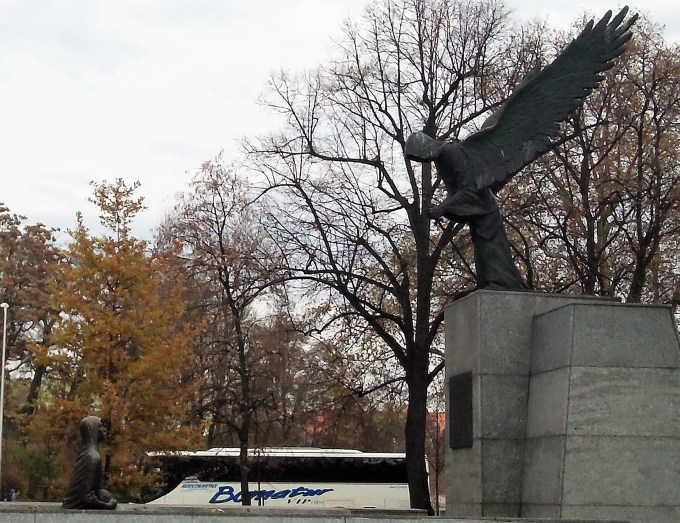
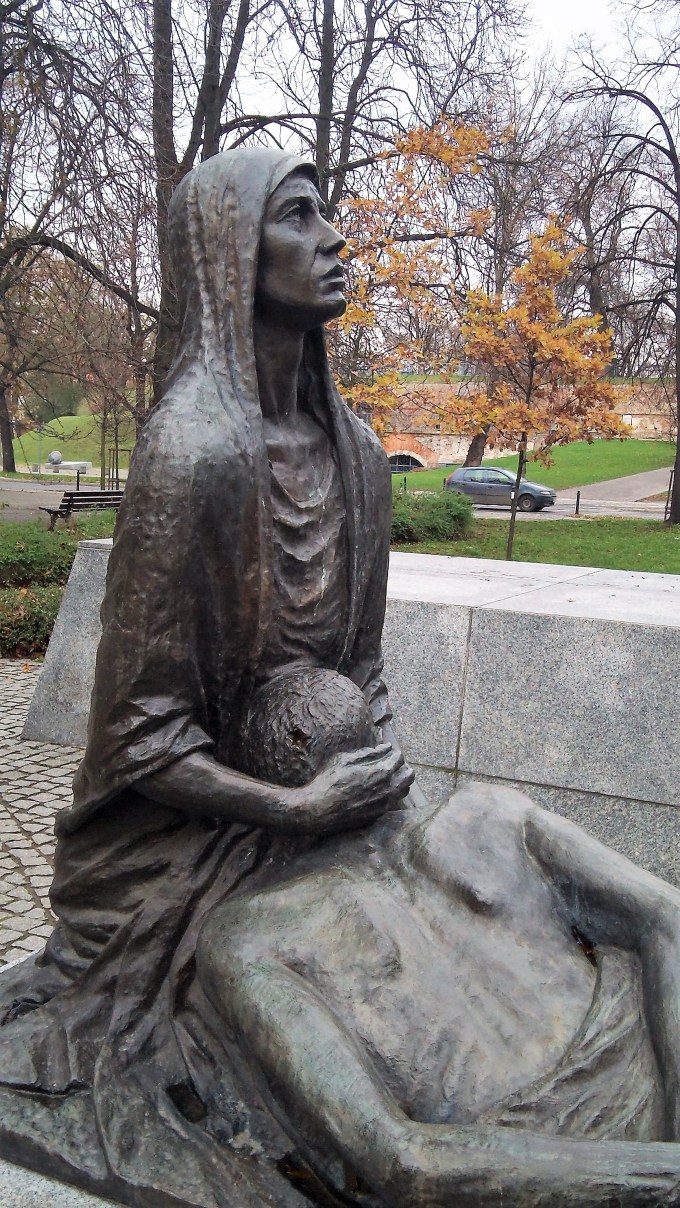


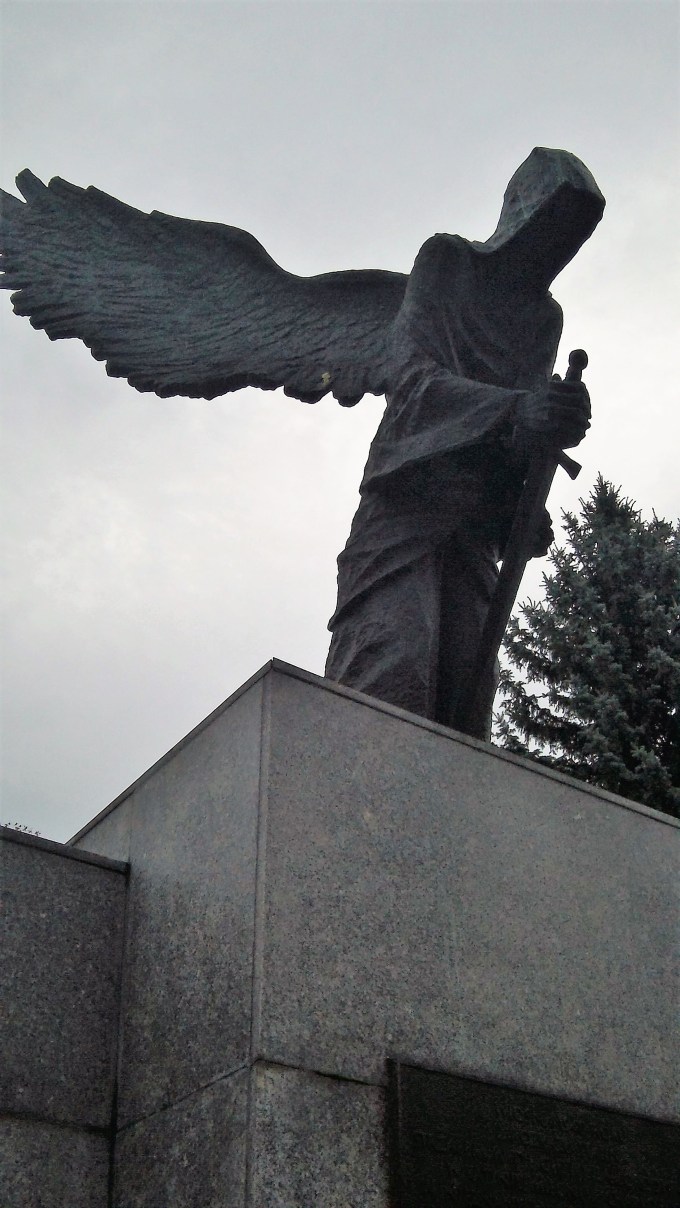
The monument to the Victims of the Katyn Forest Massacre, designed by Warsaw sculptor Tadeusz Tchórzewski, was unveiled in 2000 and can be found in the park next to the Racławice Panorama in Wroclaw.
My response to dVerse Poets Pub Meeting the Bar – Caravaggio and Chiaroscuro
Björn is the host for today’s dVerse Poets Pub Meeting the Bar, in which he has continued with his series on movements in art; he has moved back in time to the early seventeenth century and one of the most influential artists ever: Caravaggio. He has given us some factual background and a picture as inspiration of ‘Judith Beheading Holofernes’. He has also explained the technique called chiaroscuro (light-dark) that is very much connected with Caravaggio. The technique, which grew during the renaissance and was mastered by Caravaggio, entails working with shadows and the contrast between light and dark that gives his paintings a sense of being three dimensional.
Björn would like us to write poetry that creates drama by focusing on the contrast between opposites, between light and dark, good and evil, thinking like Caravaggio. We have to make the light shine and lift from the shadows, not forgetting the drama.
 writing in north norfolk
What a dark poem, and how well a sculpture can express the chiaroscuro. I have not thought about it but a sculpture in the fall is exactly like a Caravaggio painting
LikeLiked by 1 person
Yes, and the irony of it all is that the 22,000 men died in spring – I only just realised that the background is autumn!
LikeLike
A powerful poem with a very moving sculpture Kim ~ I had goosebumps looking at the pictures ~
This part really moved me:
the Katyn Pieta kneels before
the powerful wings and sword of the Angel of Death,
cradling one of the fallen dead.
LikeLiked by 1 person
Thank you, Grace!
LikeLike
seems crass to like this – but your poetry is powerful. Thank you.
LikeLiked by 1 person
Thank you for reading, Maureen.
LikeLike
Incredible stark moving…this is so an amazing poem about yet another dark time in our human history. The last line, This monument cannot be misunderstood…is a slap in the face. No, intentional murder cannot be misunderstood.
LikeLiked by 1 person
I read the plaque with tears running down my face. I can’t imagine what it would be like to visit Auschwitz.
LikeLike
Auschwitz was heartbreaking…something I will forever carry with me
LikeLiked by 1 person
Stark and to the point. A powerful and deeply moving poem.
LikeLiked by 1 person
Thank you, Paul.
LikeLike
Oh wow! Such deep heartbreak and tragedies.
LikeLiked by 1 person
Yes, it really moved m e.
LikeLike
Incredibly powerful poem, Kim. The visuals add to the pathos. A timely write considering what is happening in the world. And what happened in the past. I think of the calibrated terror of the two world wars. What happens next?
LikeLiked by 1 person
There seem to be reminders all over Wroclaw, statues, monuments and murals, which is a good thing. Young people need a nudge. There is even a building with bullet holes in it, left over from the war. I might write about that too.
LikeLiked by 1 person
Beautifully written… very moving.
LikeLiked by 1 person
Thank you!
LikeLike
This is beautifully moving, Kim.. I love how you chose to write on the sculpture.. truly incredible! ❤️
LikeLiked by 1 person
Thank you, Sanaa! The trip to Poland has more than paid for itself in inspiration!
LikeLike
“the Katyn Pieta kneels before
the powerful wings and sword of the Angel of Death,
cradling one of the fallen dead.” so beautiful and moving…thanks for the wonderful photos…
LikeLiked by 1 person
Thanks for reading, Sumana!
LikeLike
So tenderly written. Thanks for not only the poem, but the explanation, and the photographs of the monument.
LikeLiked by 1 person
I’m glad you liked them, Bryan.
LikeLike
I loved the poem, it brought home the darkness of war, any war. It reminded me of some of the WW1 poetry I read as a young woman, and also of the “hopelessness and loss”. It felt like a wound that cannot heal. Thankyou. Much Love.
LikeLiked by 1 person
Thank you for reading and for your kind comments, Alison. Much love winging its way to you.
LikeLiked by 1 person
while Death’s face is hidden by a hood.
This monument cannot be misunderstood.
The monument brought the realities of war and sufferings into the open.
Hank
LikeLiked by 1 person
Thanks for reading, Hank.
LikeLike
So
many
evils
of dArk
hidden sTiLL
as liGht too.. now..
i’m alWays amazed
when even a Roman
Emperor can be lauded
as Saint executing country
side peasants named as heathens
without
A flavor vowed
to A belief of the day..
Apocalypse dArk
Apocalypse liGht
Original Definition
oF term noW iN
Greek way iS lifting
veils of ignorance grey..
one day to walk iN liFe without
aggression.. violence.. and killing
fields same.. liFe expresSinG best as liVinG
naked
without
lies and
hidden deceit
iN clothes of status.. power..
subjugation.. yes.. and control
over ones seen and felt as different..
from a norm in all the religious and
cultural
ways
innate
too as different sAMe..:)
LikeLiked by 1 person
That’s why our poetry community is so special – there are no differences, just poets!
LikeLiked by 1 person
WiNks..
AlWays
Exclusions
From
Rules..
At
Least
One..:)
LikeLiked by 1 person
🙂
LikeLiked by 1 person
The Soviets denied responsibility until 1990. Eastern Europe is filled with mass graves dating back thousands of years. Your poem is somber and filled the pain of a ruptured nation.
LikeLiked by 1 person
I think they tried to pass the buck to the Nazis at the time but, as ever, such things can’t be denied for long. I had seen pictures of the monument and knew about the background but it wasn’t until I stood walked up to it, around it and read the plaque that I felt the pain – I cried.
LikeLiked by 1 person