Whenever I step outside my door, something new is happening.
Light shifts in a froth of new leaves, flowers are opening.
The garden and I rouse, fresh after a long dark winter.
Kim M. Russell, 2017
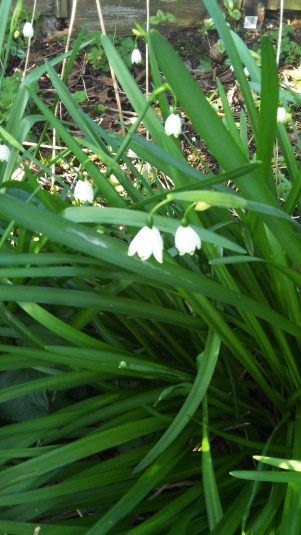
My response to Carpe Diem Universal Jane #13 Sijo the Korean poem
For this weekend’s meditation, Chèvrefeuille has brought us the Sijo, a Korean poetry form, through an article on Jane and Werner Reichhold’s website AHA Poetry.
Sijo
The spring breeze melted snow on the hills then quickly disappeared.
I wish I could borrow it briefly to blow over my hair
And melt away the aging frost forming now about my ears.
© U T’ak (1262-1342, author of this oldest surviving sijo)
He says that the Korean Sijo is even older than haiku and shares a common ancestry with haiku, tanka and similar Japanese genres, which all evolved from more ancient Chinese patterns.
Sijo is traditionally composed in three lines of 14-16 syllables each, totalling between 44-46 syllables. A pause breaks each line approximately in the middle; it resembles a caesura but is not based on metrics.
My body, in its withering, may become a lovely swallow.
Under the eaves of my loved one’s home I’ll build my nest of twigs.
After dusk I’ll fly aloft and glide gently to his side.
© Anonymous
Mind, I have a question for you – How is it you stay so young?
As the years pile up on my body, you too should grow old.
Oh, if I followed your lead, Mind, I would be run out of town.
© Anonymous
Each half-line contains 6-9 syllables; the last half of the final line is often shorter than the rest, but should contain no fewer than 5.
A drum beats in the far temple; I think it’s in the clouds.
Is it above the meadow and hill, perhaps below the sky?
Something sends a veil of mist, I cannot heed the drum.
© Anonymous
Oh that I might capture the essence of this deep midwinter night
And fold it softly into the waft of a spring-moon quilt
Then fondly uncoil it the night my beloved returns.
© Hwang Chin-i (1522-1565) most revered female Korean classical poet
The sijo may be narrative or thematic, introducing a situation or problem in line 1, development or “turn” in line 2, and resolution in line 3. The first half of the final line employs a “twist”: a surprise of meaning, sound, tone or other device. The sijo is often more lyrical, subjective and personal than haiku, and the final line can take a profound, witty, humorous or proverbial turn. Like haiku, sijo has a strong basis in nature, but, unlike that genre, it frequently employs metaphors, symbols, puns, allusions and similar word play.
You ask how many friends I have? Water and stone, bamboo and pine.
The moon rising over the eastern hill is a joyful comrade.
Besides these five companions, what other pleasure should I ask?
© Yon Son-do (1587-1671)
Let me ask you, butterfly, do you remember your cocoon?
Perhaps you recall spinning thread, a caterpillar’s ungainly crawl?
If we can jog your memory, maybe there is hope for me.
© Jane Reichhold
 writing in north norfolk
A very fresh spring sijo !
LikeLiked by 1 person
Thank you, Virginia!
LikeLike
Love the last line – it hope and action to the beauty of Spring
LikeLiked by 1 person
Thank you, Candy!
LikeLike
Excellent!
LikeLiked by 1 person
🙂
LikeLike
The Sijo is a beautiful poetry form and this one you have shared is really nice Kim.
LikeLiked by 1 person
Thank you, Kristjaan!
LikeLiked by 1 person
Kim, your words made this form appear easy to write. But it is not. Great job.
LikeLiked by 1 person
Thank you, Janice!
LikeLiked by 1 person